The most expensive mistake in software development is not slow coding.
It is building the wrong solution, for the wrong user, with more scope than the problem justifies.
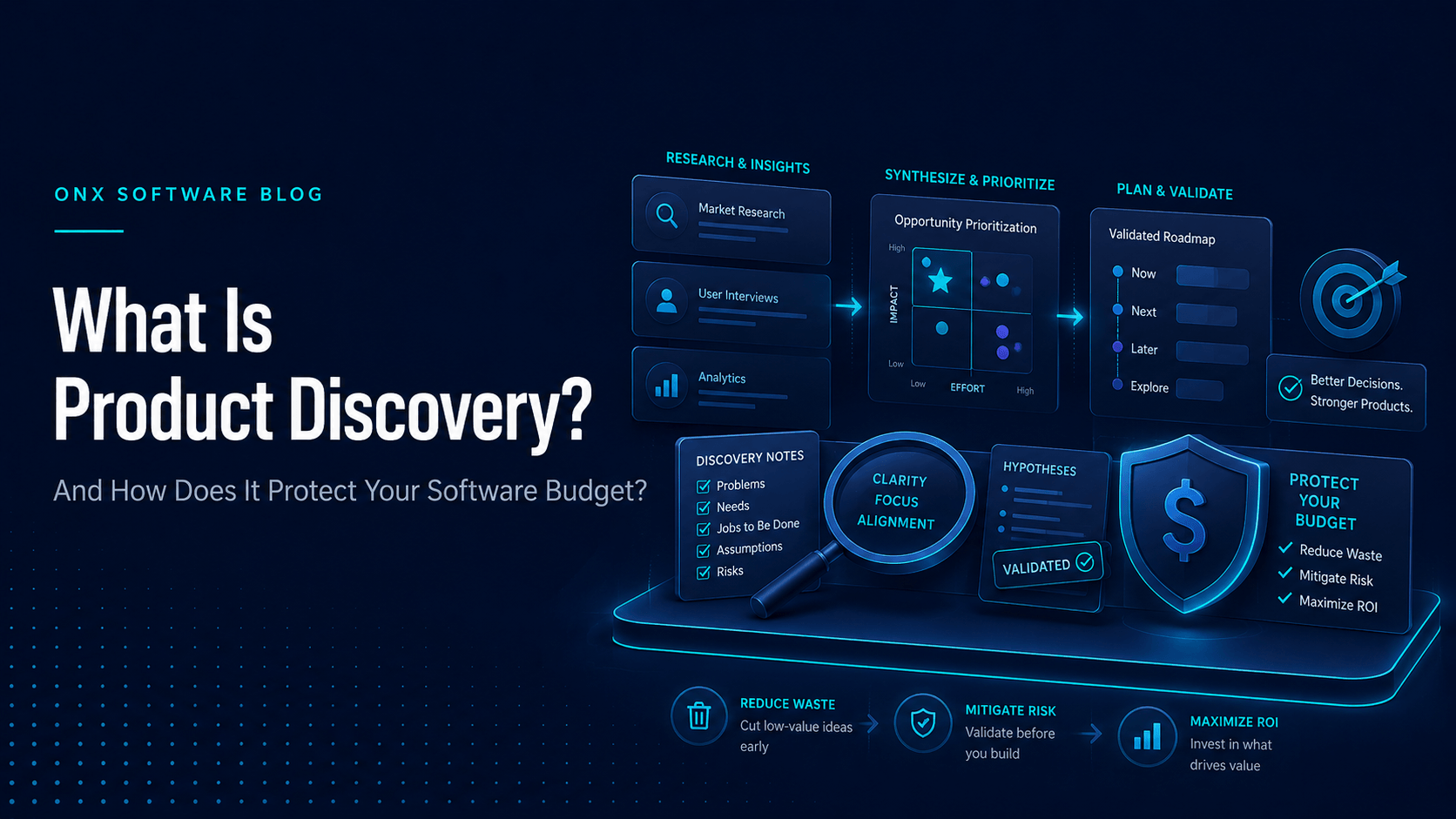
Product discovery is the process of reducing the most important uncertainties before committing heavily to design and development. It is not an attempt to answer every possible question in advance. It is a way to make better investment decisions while changes are still relatively inexpensive.
A well-run discovery process creates clarity around questions such as:
- What is the real problem?
- Who experiences it?
- Why are current alternatives insufficient?
- Does the proposed solution fit actual user behaviour?
- What belongs in the first release?
- Which technical risks could change the plan?
- How will success be measured?
These questions can also be answered during development. The difference is that, by then, every incorrect assumption may already carry the cost of design, code, testing, integration, and rework.
What product discovery is not
Discovery is sometimes perceived as a long, theoretical consulting phase that delays the “real work.” That can happen when the process is poorly designed. The depth of discovery should always reflect the size and risk of the project.
Product discovery is not:
- Producing hundreds of pages of documentation
- Fixing every feature before development begins
- Researching indefinitely without showing anything to users
- Delaying development without a clear reason
- Attempting to predict the entire future of the product
Its purpose is to identify the most expensive mistakes before they become expensive.
What happens during product discovery?
The exact activities depend on the project, but a healthy discovery process usually covers the following areas.
Stakeholder interviews
Founders, executives, operations teams, sales, customer support, and technical teams often see the same problem differently.
In an education product, management may want central reporting, teachers may want less data entry, and students may need a simpler experience. If those expectations remain hidden, the product may be optimised for one group while becoming difficult or unusable for another.
Stakeholder interviews expose these differences early and make trade-offs visible.
User and problem research
Discovery looks not only at what users say, but also at what they currently do.
- Which tools do they use?
- Where do they wait?
- Which information do they enter repeatedly?
- Which steps do they skip?
- Which workarounds have they created?
Observing the actual workflow, reviewing real examples, or watching a screen recording can reveal more than a general conversation about preferences.
Business model and value proposition
The team examines who receives the value, what outcome the product creates, and how that value can become a sustainable business.
The user who likes the product may not be the person who pays for it. Purchase criteria, pricing assumptions, procurement constraints, and distribution channels therefore belong in discovery as much as user experience does.
User journeys and prototypes
Core scenarios are translated into visible flows and prototypes before full production development begins.
A prototype is not only for evaluating visual design. It helps determine whether users understand the sequence, can complete the task, and receive the right information at the right time.
Changing an interaction in a prototype is far less expensive than changing a live product after frontend, backend, data, and tests have all been built around it.
Technical discovery
The team investigates integrations, data structures, security, performance, third-party services, infrastructure, and other technical uncertainties.
Early technical research is especially important when the product involves:
- Data migration from legacy systems
- Protection of health, student, or other sensitive information
- AI output accuracy and review
- Video or media processing
- Real-time systems
- Offline use
- High user volumes
- Multi-tenant, multi-institution, or multi-country architecture
Technical discovery does not eliminate uncertainty. It identifies the unknowns that could have the greatest impact on cost, timing, and feasibility.
Scope and prioritisation
Not every request should be treated as equally important.
Discovery separates the journey that proves the core value from features intended for later growth. The outcome often groups requirements into:
- Essential for the first release
- Important for adoption or purchase
- Suitable for a later phase
- Requiring further research
- Out of scope for now
This is where the project begins to move from a wish list towards an investment plan.
How discovery protects the budget
It removes unnecessary features early
It is inexpensive to remove a weak idea from a workshop, flow, or prototype. Removing it after design, development, and testing does not recover the money already spent.
It prevents the wrong journey from being coded
A workflow can often be revised in hours or days at the prototype stage. The same change in a working system may affect the data model, frontend, backend, permissions, integrations, and automated tests.
It reduces technical surprises
A project can change significantly if an integration is unavailable, source data is incomplete, or a third-party service has unexpected limits.
Discovery cannot reveal every future issue, but it can bring high-impact uncertainties into the plan before they disrupt delivery.
It produces more comparable proposals
Large differences between software proposals are normal when the requirement is vague. Each team fills the gaps with different assumptions about quality, roles, infrastructure, integrations, and scope.
After discovery, user journeys, technical needs, and priorities are clearer. Proposals become easier to compare because they are based on more consistent information.
It makes phased investment possible
One of the most effective ways to protect a budget is to avoid funding the entire vision in the first release.
Discovery identifies the smallest phase that can create value or reduce a major risk. The organisation can then invest further based on evidence rather than optimism alone.
It reduces rework
A weak data model, permission structure, or product architecture may look fast at the beginning but create significant rework later.
Discovery does not mean building every future capability in advance. It means recognising decisions that could block the next stage of growth entirely.
What should a discovery process produce?
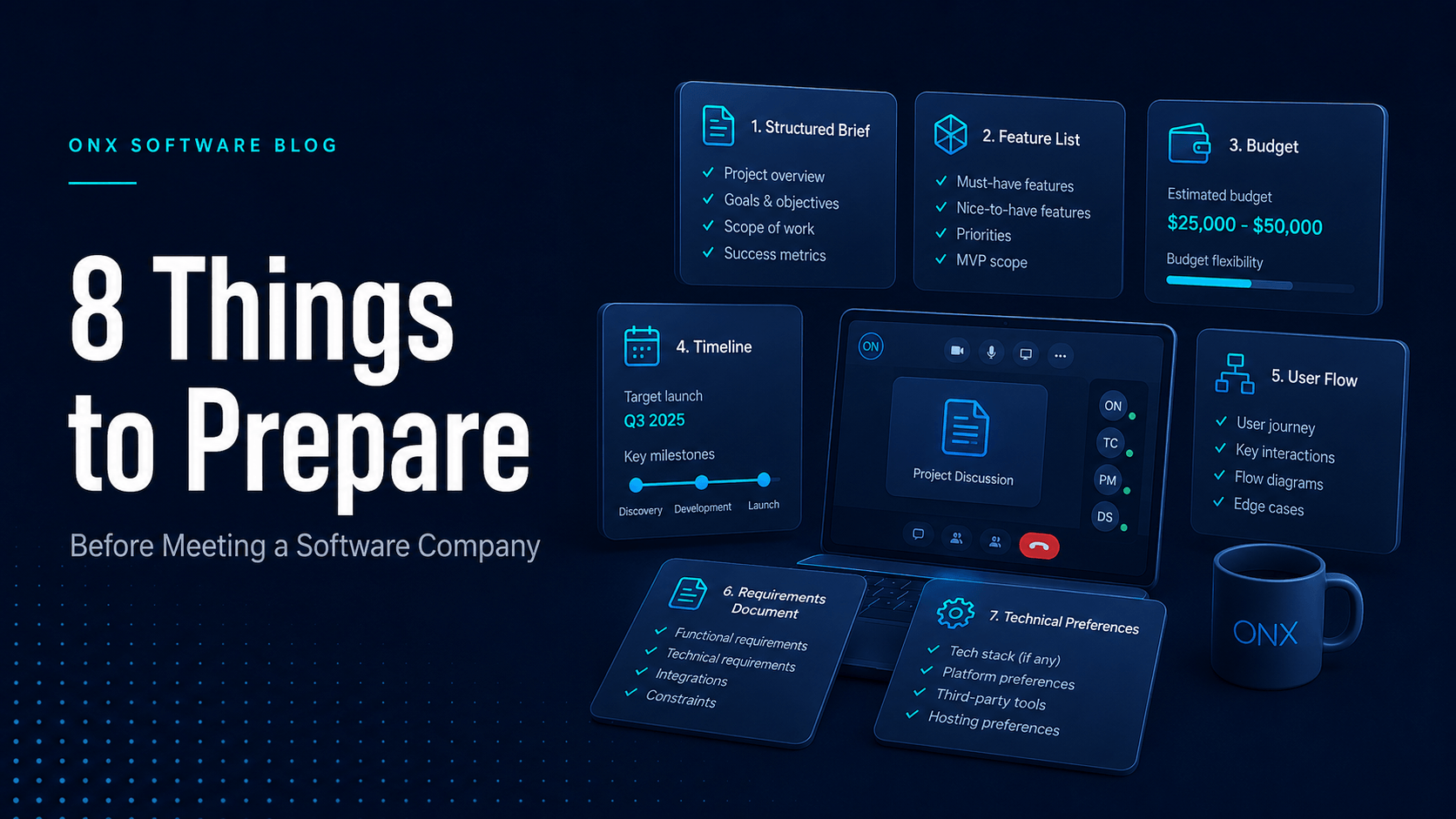
Outputs vary according to the size of the project, but discovery should result in practical artefacts that support decisions. These may include:
- A clear problem and target-user definition
- User roles and responsibilities
- Current and target workflows
- A refined value proposition
- A prioritised product scope
- A prototype or core screen flows
- Technical approach and risk register
- Integration requirements
- A phased roadmap
- An estimated effort or budget range
- Success metrics
These are not permanent contracts. They are shared reference points that reduce ambiguity and guide development decisions.
Does every project need discovery?
Not every project requires a long discovery phase. A small, standard, well-defined application may need only a few focused meetings and a short technical review.
Discovery becomes more important when:
- There are several user roles.
- The product creates a new business model.
- Existing systems must be integrated.
- Sensitive health, education, financial, or personal data is involved.
- AI is central to the product’s value.
- The current process depends on several manual tools.
- A complex operation is being digitised for the first time.
- Budget or time is limited.
Skipping discovery can feel attractive when resources are constrained. In reality, limited resources make the cost of building the wrong scope even harder to absorb.
Across nearly 20 years of software experience—including hospital systems, tourism technology, and long-running EdTech projects—we have seen many budget overruns originate not in coding speed, but in business and product decisions discovered too late.
Product discovery is not an additional cost placed in front of the project. Done well, it is a mechanism for protecting the investment by deciding which problem deserves the budget, which risks need to be tested, and what should be built first.
Starting development earlier does not always mean reaching the market earlier. Sometimes the fastest route begins with asking the right questions.