Explaining a business idea is often easy.
“What if there were an app that did this?”
“What if we could manage the entire process from one screen?”
“What if AI could make this task faster?”
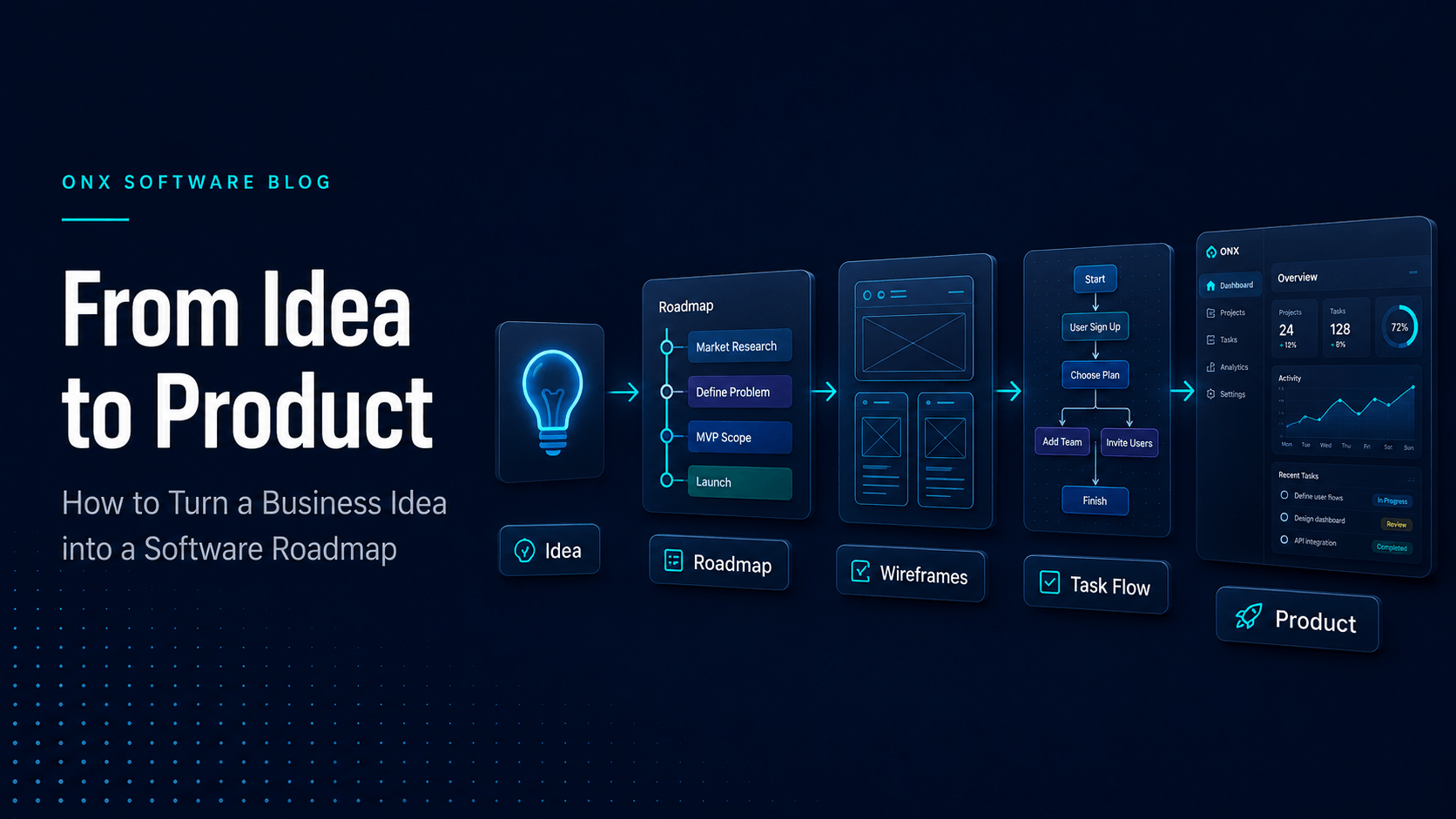
Sentences like these can be the starting point for a valuable product. The harder part is turning the idea into a software plan that can be designed, estimated, built, tested, and measured.
A software roadmap is not a long list of features arranged by date. It is a decision framework that shows which problem the product will solve, for whom, in what order, and why that order matters.
1. Define the problem before the solution
Many projects begin with a solution statement:
We want to build a mobile application.
This explains what the team wants to create, but not why it needs to exist.
A stronger starting point might be:
Our field team records customer-visit information across several channels. Reports are delayed, data is lost, and managers cannot see the current status of accounts.
That problem statement makes it possible to assess whether a mobile application is actually the right answer. Perhaps it is. Perhaps a lightweight interface added to an existing system would solve the issue more efficiently.
At the beginning, answer these questions:
- Who experiences the problem?
- How frequently does it occur?
- How is it handled today?
- What does the current approach cost in time, money, quality, or missed opportunity?
- What meaningful result would change if the problem were solved?
2. Separate the user from the customer
In B2B and B2B2C products, the person using the product may not be the person paying for it.
An EdTech platform might serve students, teachers, school administrators, parents, and publishers within the same ecosystem. Students may use the product daily, while the school administration makes the purchase. If the teacher experience is poor, adoption fails. If the administrator cannot access the necessary reporting, the sale may never happen.
For each role, identify:
- The main need
- The outcome they expect
- The critical moment of use
- The main barrier to adoption or purchase
- The indicator of success
Without this work, roadmaps tend to fill up with competing feature requests that do not add up to a coherent product.
3. Define the business outcome
A software project is not successful simply because it is launched. Launch is a technical milestone, not a business result.
The objective should be as measurable as possible. For example:
- Reduce manual processing time by 50 per cent
- Run pilots with 20 institutional customers in the first three months
- Increase weekly active use among teachers
- Reduce reservation errors
- Cut report preparation time from two days to two hours
- Create a new subscription-revenue stream
Business outcomes influence prioritisation. A feature that is essential for reducing operational errors may not be important for testing willingness to pay, and vice versa.
4. Make assumptions visible
Every product concept contains assumptions. The danger is not having assumptions; it is treating them as established facts.
Examples include:
- Users will be willing to install another application.
- Schools will not require integration with their existing systems.
- Customers will accept a monthly subscription.
- AI-generated outputs will be reliable enough for the intended task.
- Users will upload and maintain their own content.
The early roadmap should be designed to test the assumptions that could invalidate the product or business model.
The technically hardest feature is not always the highest-risk issue. The biggest risk may simply be that customers do not care enough about the problem to change their behaviour or pay for a solution.
5. Map the key user journeys
Before creating a feature list, map the main user journeys.
In an education platform, an “assignment module” may appear to be one feature. In reality, the journey could include:
- The teacher selects a class.
- The teacher chooses content or questions.
- A due date is set.
- The student receives the assignment.
- The student submits answers.
- Results are calculated.
- The teacher reviews performance.
- Feedback is provided where necessary.
Once the journey is visible, missing requirements, unnecessary steps, role conflicts, and integration needs become easier to identify.
6. Prioritise features by outcomes
The first release does not need to include every good idea. Features can be grouped into four categories:
- Capabilities that create the product’s core value
- Capabilities required for adoption or purchase
- Capabilities that can wait until a later phase
- Capabilities that should not be built yet
Three questions help determine priority:
- Which business outcome does this support?
- Which user problem does it solve?
- Would the first release fail without it?
When a feature cannot be connected to a clear user or business outcome, it is probably not essential for the first phase.
7. Investigate technical uncertainty early
Some products contain technical uncertainties that can reshape the entire roadmap:
- Integration with legacy systems
- Large-scale data migration
- Video processing
- Real-time communication
- AI model accuracy
- Protection of sensitive health or student data
- Offline use
- High levels of simultaneous traffic
If these issues emerge after development begins, cost and timing can change significantly. A short technical spike or proof of concept may need to appear at the beginning of the roadmap rather than halfway through delivery.
8. Build phases around learning, not just output
A healthy roadmap often includes the following stages.
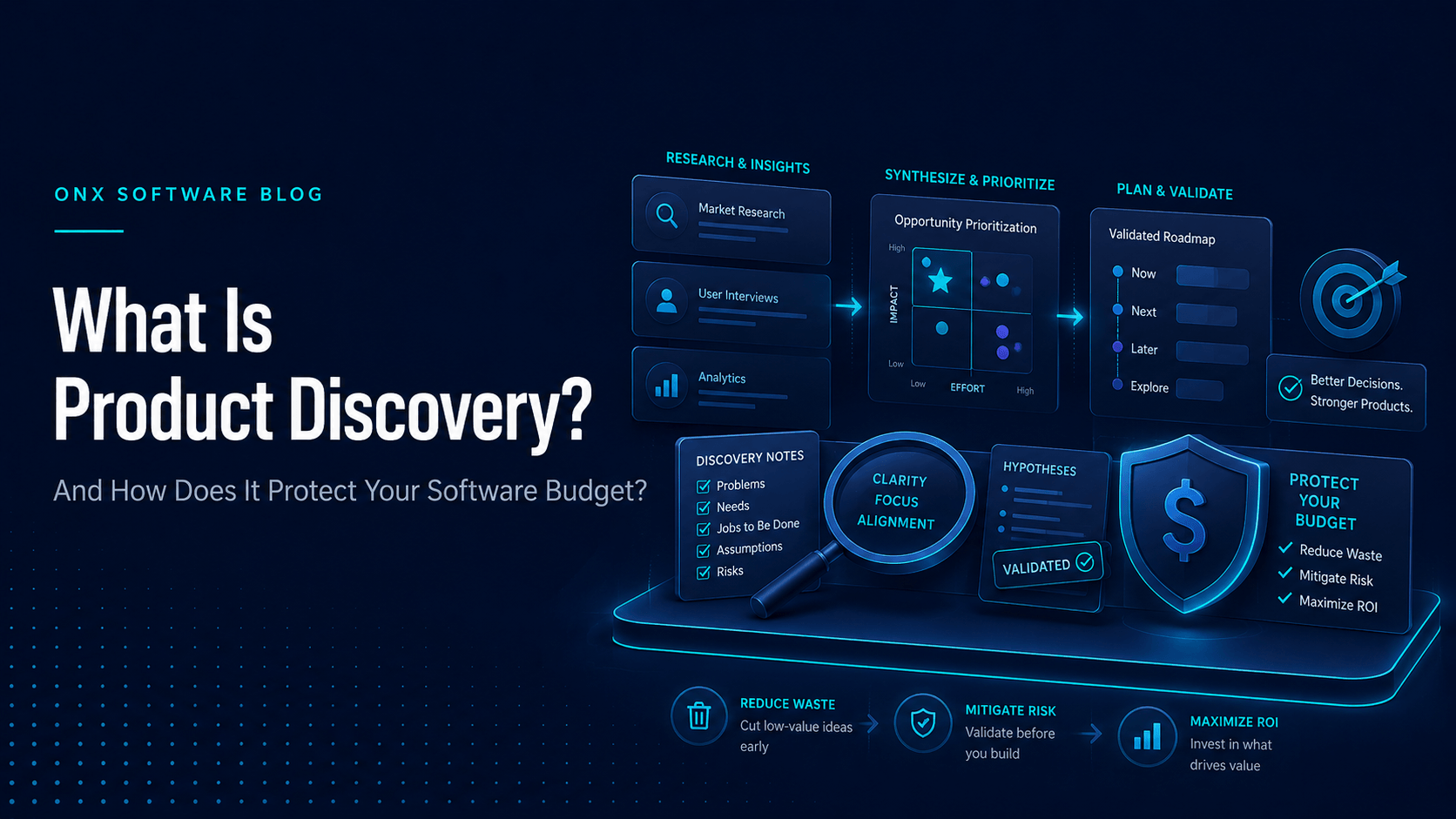
Discovery and validation
Clarify the problem, users, business model, and technical risks.
Prototype
Test journeys and experience with little or no production code.
Initial product
Build a working version that allows the core value proposition to be tested with real users.
Market readiness
Strengthen security, performance, onboarding, analytics, support, pricing, and operational readiness.
Scale
Use real usage data to plan new capabilities, automation, and infrastructure improvements.
Each phase should end with a learning or business result. “The module is complete” is less useful than “the first pilot customers are now using the product every week.”
A roadmap is not a fixed contract with the future
Markets change. User behaviour changes. Technical discoveries force new decisions. A roadmap should evolve as the team learns.
That does not mean working without a plan. It means managing the plan according to evidence rather than defending early assumptions at all costs.
Across projects in healthcare, tourism, and especially EdTech, we have repeatedly seen the same pattern: successful products do not begin with the longest feature list. They begin with the clearest problem and the clearest definition of first-stage success.
The purpose of a roadmap is not to predict the entire future. It is to create enough clarity to make the next important decision well.