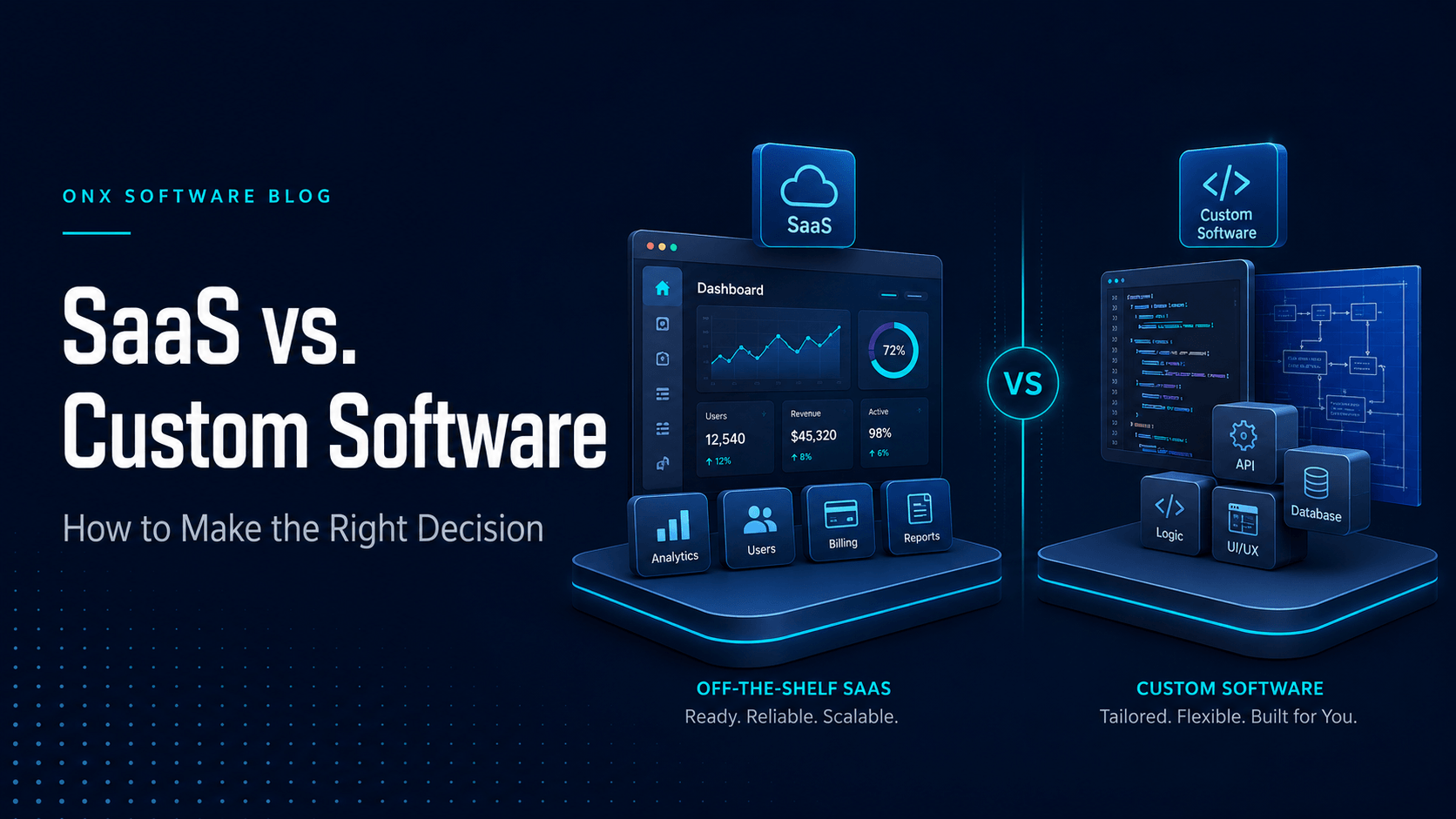
When a business decides to digitise a process, two options usually come to the table: subscribe to an off-the-shelf SaaS product or build software around the organisation’s specific needs.
At first glance, the choice can seem straightforward. SaaS appears faster and less expensive, while custom software promises greater flexibility. In practice, however, the right decision cannot be made by comparing initial costs alone.
The more important question is this:
Are you solving a common operational problem, or is the process part of what makes your business different?
Getting that distinction right can prevent months of work, expensive migrations, and long-term dependence on a tool that never truly fits.
When off-the-shelf SaaS is the better choice
Many business processes are already well standardised. Email marketing, accounting, team communication, basic CRM, project management, and file sharing are good examples. In these areas, an established SaaS product will often meet the needs of most organisations.
An off-the-shelf solution is usually a strong option when:
- Your requirement is common across industries.
- You are comfortable adapting your process to the software.
- You need to get started quickly.
- Your initial budget is limited.
- The software is not expected to create a strategic advantage.
A small sales team that only needs to track leads and opportunities may be well served by an existing CRM. A tourism business with a standard booking workflow may also find that an established reservation platform covers most of what it needs.
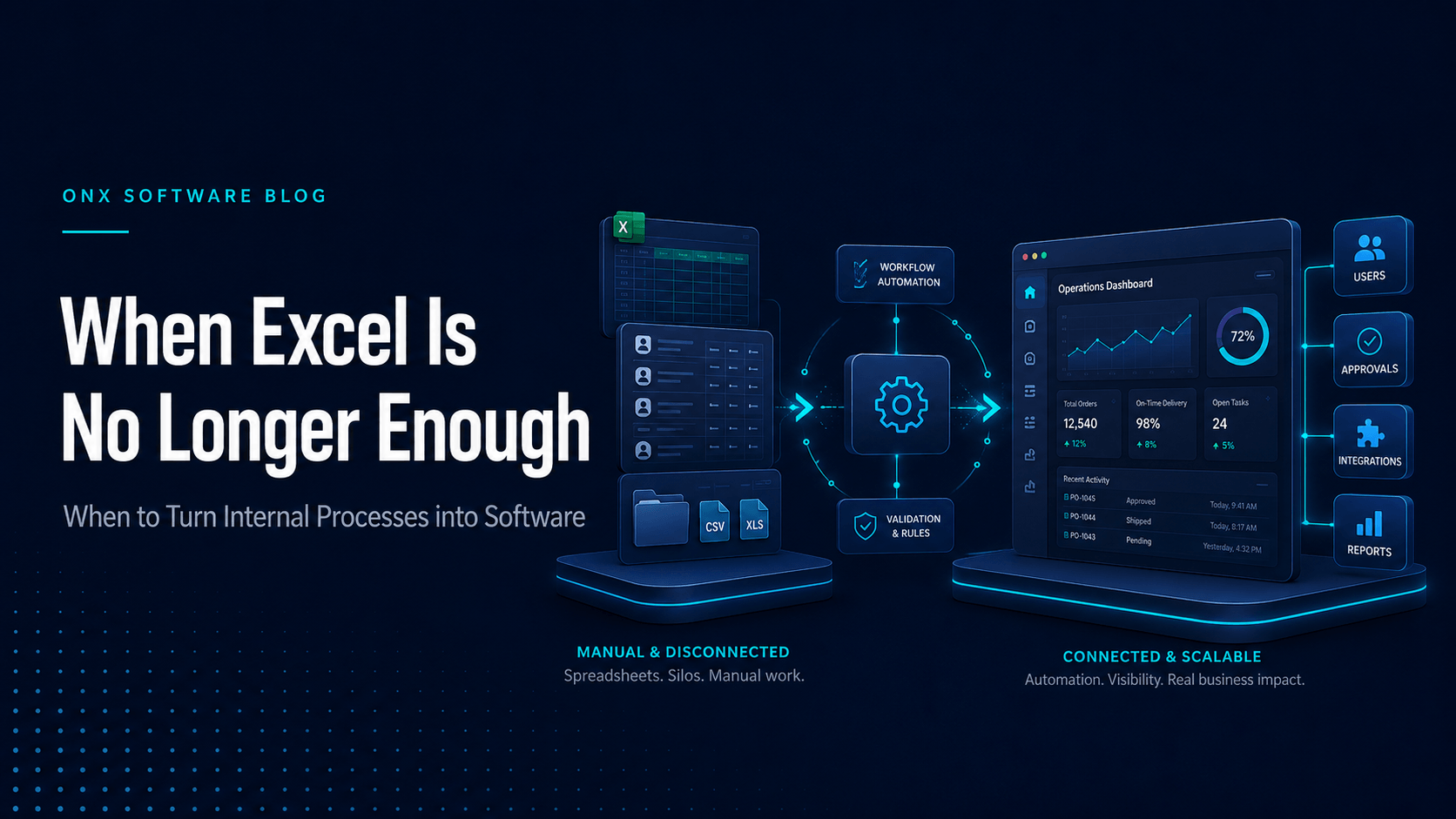
The real test is whether the software supports the work or forces the team to work around it. When employees begin using spreadsheets, WhatsApp groups, email threads, and manual notes to compensate for missing workflows, the organisation may be paying for software without actually solving the process.
When custom software becomes the stronger option
Custom software should not be understood as simply having your own screens or brand colours. Its real value is the ability to translate an organisation’s distinctive workflows into technology without losing the logic that makes those workflows effective.
It deserves serious consideration in the following situations.
Your process does not fit standard products
An educational publisher may need to connect content production, editorial review, teacher workflows, student progress, licensing, and institutional reporting within a single system. General-purpose tools may address each activity separately, yet still fail to manage the complete process efficiently.
The same applies in healthcare. Appointment scheduling may be standard, but a hospital can have specialised clinical workflows, device integrations, reporting obligations, permission structures, and data-governance requirements that call for a custom solution.
Software is central to your business model
When the value you sell depends directly on the software, using the same standard product as every competitor can become a strategic limitation.
For a SaaS company, a digital learning platform, or a technology-led tourism business, software is not simply an internal tool. It is the product—or at least a core part of the customer experience.
In that case, control over the roadmap, user experience, data, and product evolution becomes strategically important.
You need several systems to work together
SaaS products typically support a defined set of integrations. Problems emerge when your business needs a tailored flow between an ERP, payment provider, content system, mobile application, CRM, internal database, or reporting environment.
Without the right integrations, teams may end up entering the same information into multiple systems, combining reports manually, or leaving critical workflows incomplete because of API limitations.
Licensing costs increase sharply as you grow
Off-the-shelf SaaS can look inexpensive at the beginning. But total cost changes as the number of users, transactions, locations, storage requirements, or add-on modules grows.
A realistic calculation should include more than the monthly subscription:
- Per-user fees
- Mandatory upgrades to higher plans
- Integration and implementation costs
- Data export or migration limitations
- Operational inefficiency caused by a poor process fit
- The cost of switching providers later
Custom software often requires a larger upfront investment. In the right scenario, however, it can offer greater long-term control and a more favourable cost structure.
Six questions to ask before deciding
1. Does this process differentiate us from competitors?
If the answer is no, buying an existing tool is often the sensible option. If the answer is yes, handing that process over to a vendor’s standard workflow may create long-term risk.
2. Can we adapt our workflow to the product?
Some processes can be changed without consequence. Others are shaped by regulation, customer expectations, operational dependencies, or sector-specific practices. You need to know which category you are dealing with.
3. What will our user and transaction volumes look like in two years?
Do not calculate only for today. Model the cost and operational fit under realistic growth scenarios.
4. Which data must remain under our control?
Data ownership, exportability, security, backups, and vendor dependency can be especially important in sectors such as healthcare and education.
5. What percentage of our requirement does the SaaS product actually cover?
If it covers 80 to 90 per cent of the requirement, adapting the process may be reasonable. But if the missing 10 or 20 per cent includes the organisation’s most critical workflow, that gap can undermine the value of the entire investment.
6. Is software a tool for us, or is it part of the product?
This question often clarifies the decision. If software is mainly a supporting tool, buying usually makes sense. If it is central to the value you deliver, building may be the stronger strategic choice.
The third option: a hybrid approach
The decision does not always have to be all buy or all build. In many projects, a hybrid model creates the best balance.
Reliable third-party services can be used for authentication, payments, email delivery, analytics, or file storage, while the organisation’s distinctive workflows and customer experience are developed as custom software.
This avoids reinventing mature infrastructure while preserving investment for the areas that create differentiation.
Across nearly 20 years of software work—from hospital systems and tourism platforms to more than 12 years in EdTech—we have seen the same principle repeatedly: custom software is not automatically the most expensive option.
The most expensive option is often staying too long with the wrong solution.
A sound decision considers cost, speed, control, growth, risk, and competitive advantage together. Before choosing the technology, define the problem without assuming the answer. That is usually the most valuable first step in any software investment.