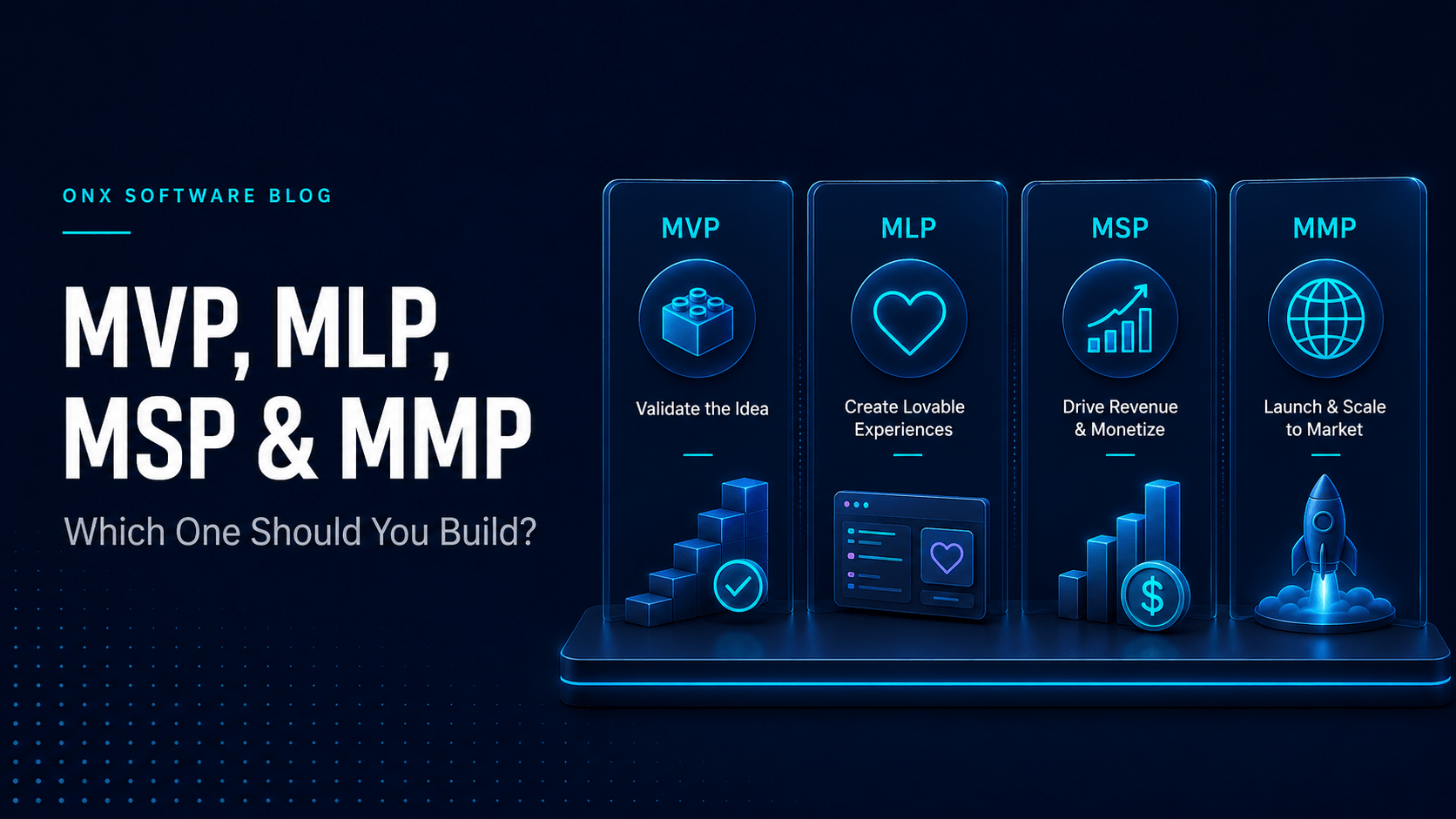
Product teams now encounter an expanding set of “minimum product” terms: MVP, MSP, MMP, and MLP. They may sound like competing versions of the same idea, but each one answers a different business question.
- An MVP tests whether the core product idea works.
- An MSP identifies the smallest product a customer will pay for.
- An MMP focuses on whether the product is ready to be marketed repeatedly.
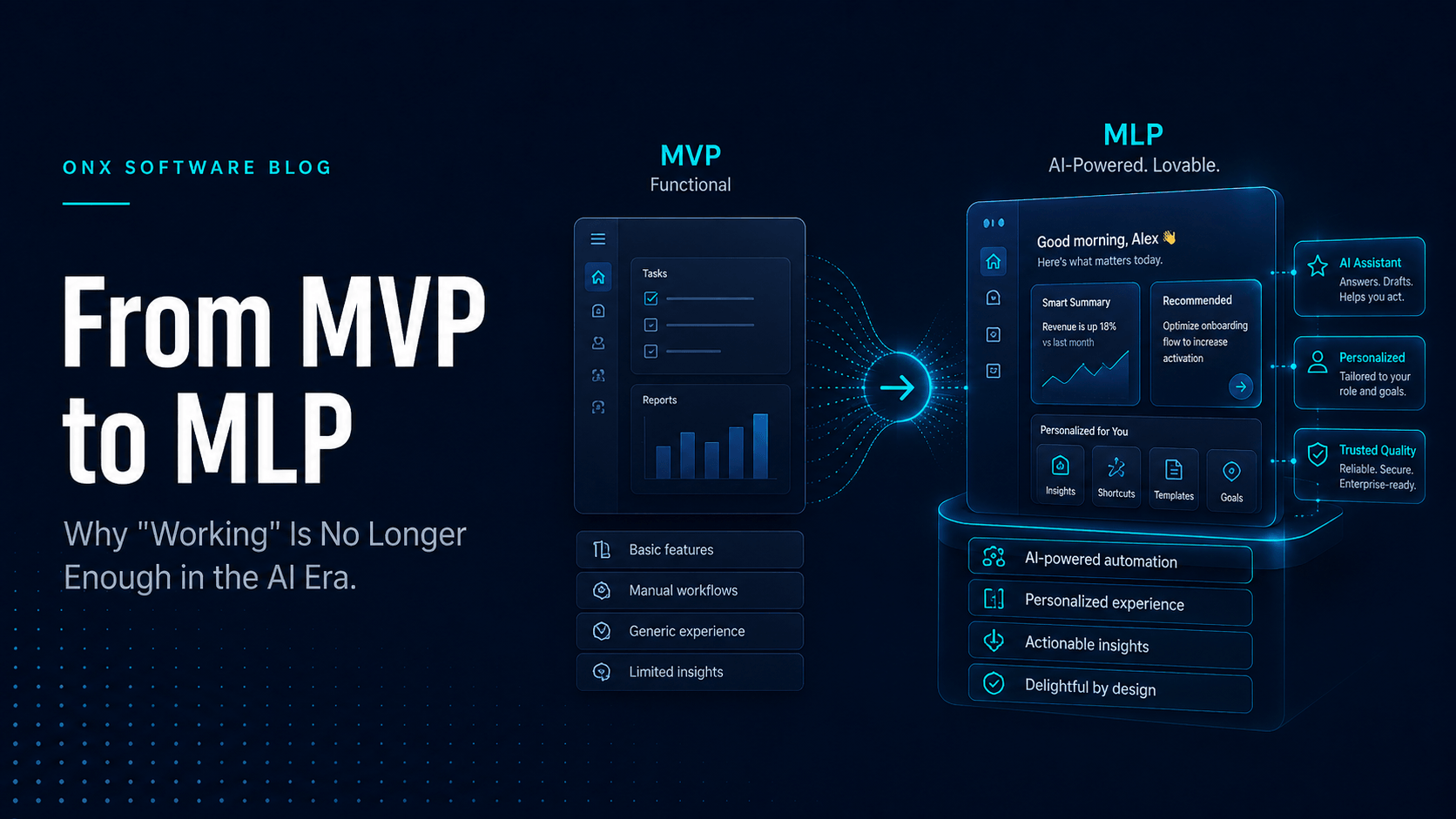
- An MLP aims to create an experience users will not only tolerate, but prefer.
Choosing the right framework is not a matter of terminology. It depends on the stage of the product and, more importantly, the risk the team needs to reduce next.
MVP: Minimum Viable Product
A Minimum Viable Product is the smallest coherent version of a product that allows a team to test its most important assumption with real users.
Its purpose is not to launch a perfect first version. It is to learn whether the core problem is real and whether the proposed solution creates enough value to justify further investment.
Suppose you are developing a digital learning product based on this assumption:
Teachers want one place to assign work and monitor student performance.
You do not need an advanced content editor, parent application, complex analytics suite, AI recommendation engine, and dozens of administrative tools to test that assumption. A focused flow in which a teacher can create a class, assign an activity, and review the results may be enough.
The MVP should answer:
Is this problem real, and do users engage with the core solution?
The most common mistake is treating “minimum” as an excuse for a careless or unreliable product. An MVP can be narrow in scope, but the essential journey still needs to work. Minimum does not mean broken, confusing, or unsafe.
MSP: Minimum Sellable Product
A Minimum Sellable Product is the smallest version of a product that a specific customer is prepared to pay for.
There is an important difference between a user trying a product and a customer buying it. Purchase decisions often require more than the core function. Buyers may also expect trust, support, reporting, security, integrations, onboarding, and contractual clarity.
This distinction is especially visible in B2B products. A school administrator may like the demo of a learning platform, but still require central user management, permissions, class imports, institutional reporting, data safeguards, and technical support before approving a purchase.
The MSP should answer:
What is the minimum combination of value and confidence required for the target customer to pay?
MMP: Minimum Marketable Product
A Minimum Marketable Product is the smallest product that can be positioned, sold, delivered, and supported in a repeatable way within a defined market.
At this stage, the product is no longer a solution being tested with a handful of early users. It is becoming an offer that can be explained clearly and adopted by a broader group of customers.
That requires more than product features. The surrounding commercial and operational system also matters:
- Clear positioning
- A defined customer segment
- Understandable pricing
- A repeatable onboarding process
- A support model
- Usage analytics
- Baseline security and performance standards
The MMP should answer:
Can we take this product to a defined market with a repeatable message, sales process, and delivery model?
A tourism technology product may create clear value in two pilot hotels. But reaching the MMP stage requires other hotels to onboard through a standard process, train their teams efficiently, understand the pricing, and receive reliable support without every deployment becoming a custom project.
MLP: Minimum Lovable Product
A Minimum Lovable Product is the smallest version of a product that creates a positive, memorable experience—one users are willing to return to and recommend.
“Lovable” does not mean decorative or overloaded with delightful animations. It usually comes from making the user feel understood at the moments that matter most.
A product may become lovable because it:
- Makes the first session easy
- Removes unnecessary steps
- Explains what to do after an error
- Feels fast and dependable
- Includes small but thoughtful details
- Eliminates a painful task in a noticeably better way
The MLP should answer:
Why would a user choose to come back and recommend this product to someone else?
Are these frameworks alternatives to one another?
Usually, no. It is more useful to think of them as different lenses for reducing different types of product risk.
A product might progress through the following sequence:
- Validate the core problem and solution with an MVP.
- Validate willingness to pay with an MSP.
- Build a repeatable go-to-market offer with an MMP.
- Improve preference and retention through an MLP mindset.
That sequence will not be identical for every product.
In a consumer application, a lovable experience may be essential from the very first release. In enterprise healthcare software, accuracy, security, integration, and auditability may matter more than visual polish. In B2B SaaS, the economic buyer may have very different expectations from the day-to-day user.
Which one should you build?
You are not yet sure the problem is real: build an MVP
Test whether the target user genuinely experiences the problem and whether the core solution changes their behaviour.
People use the product, but nobody pays: move towards an MSP
Investigate what customers are willing to buy, which capabilities affect the purchase decision, and whether pricing reflects the value delivered.
You have early customers, but growth is not repeatable: define the MMP
Standardise the product, onboarding, pricing, support, positioning, and sales process so that every new customer does not require a separate project.
Users sign up, but do not return: apply an MLP mindset
Focus on friction, trust, first value, emotional relevance, and the reasons users should come back.
The biggest mistake: building around the acronym
Teams sometimes decide that they “need an MLP” or “must move to MMP” and turn the framework itself into the objective.
A better starting point is to identify the risk:
- Is there market risk?
- Usage risk?
- Revenue risk?
- Distribution risk?
- Experience or retention risk?
The right minimum-product approach follows from the answer.
Across nearly two decades of software development, we have worked on products at many stages—from first concepts to scalable platforms. The healthiest projects were not simply the ones with the smallest first release. They were the ones that were clear about what the first release needed to prove.
A strong early product does not do everything. It does the right thing well enough to make the next investment decision more informed.